The Hidden Cost of "Just in Case"
Over-ordering costs the average independent café $200–400 per month in wasted product, tied-up cash, and storage inefficiency. The root cause is almost always the same: ordering based on gut feel instead of actual usage data, which leads to buying "just in case" across 50+ items every week. Here are six practical strategies to stop over-ordering, starting with the ones that save the most money with the least effort.
Over-ordering costs the average independent café $200-400 per month in wasted product, tied-up cash, and storage inefficiency. For a business running on thin margins, that's the difference between a good month and a stressful one.
Why Over-Ordering Happens
1. Ordering by Feel Instead of Data
"I think we need more oat milk" is not a reorder strategy. Without actual usage data, you're estimating — and humans consistently overestimate how much they need. It's a survival instinct: running out feels worse than having too much.
2. No Visibility Into Current Stock
If you don't know exactly what you have, you can't make informed ordering decisions. Walking into the stockroom and eyeballing the shelf is not the same as knowing you have 4.5 cases of oat milk and you use 6 per week.
3. Ignoring Supplier Lead Times
If your dairy supplier delivers next-day but your packaging supplier takes a week, you shouldn't order them on the same timeline. Yet most café owners place all their orders on the same day with the same buffer — leading to too much of one thing and too little of another.
4. Bulk Discount Temptation
"Buy 10 cases and save 15%!" Sounds great until 3 cases expire before you use them. The discount only saves money if you actually use everything before it goes bad.
5. No Review Process
When was the last time you looked at what you threw away and traced it back to an ordering decision? Most cafés don't have a waste-to-ordering feedback loop.
6 Strategies That Actually Work
1. Count Before Your Delivery, Not After
This is the single most impactful change you can make. When you count inventory right before a delivery arrives, you capture exactly how much you used since the last count. After the delivery, your numbers include the new stock and you lose that usage signal.
Count → Order → Receive. In that order.
2. Set Par Levels Based on Data
Stop guessing. Calculate par levels using your actual weekly usage:
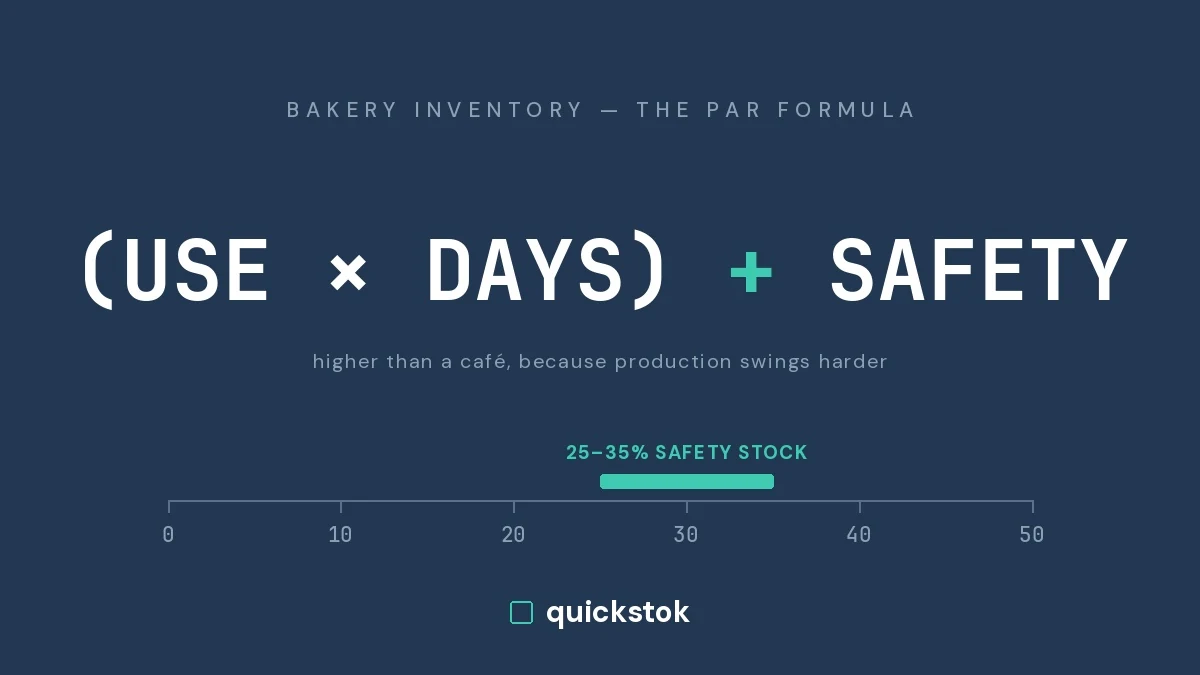
Par = (Average Weekly Usage × 1.5) + Safety Stock
For an item you use 6 cases/week with moderate variability:
- Par level: (6 × 1.5) + 2 = 11 cases
When your count shows 11 or below, order. Above 11? Don't.
3. Track Your Supplier Lead Times
Know exactly how long each supplier takes to deliver:
- Sysco: 2 days
- Local dairy: next day
- Specialty roaster: 5 days
- Amazon: 2-3 days
Your buffer stock should reflect these differences. A next-day supplier needs 1-2 days of safety stock. A 5-day supplier needs 5-7 days.
4. Review Waste Weekly
Spend 10 minutes every Monday looking at what got thrown out last week. Write it down. After a month, you'll see patterns:
- "We always throw out 2 croissants on Tuesdays" → reduce Tuesday prep
- "Almond milk expires before we finish it" → order smaller quantities more often
- "We over-prepped cold brew again" → adjust the batch size
5. Use FIFO Religiously
First In, First Out. New stock goes behind old stock. Always. This is basic but an astonishing number of cafés don't do it consistently, leading to expired product hiding behind fresh product.
Label everything with the delivery date. Make it a rule, not a suggestion.
6. Match Your Order Frequency to Your Usage
High-usage items (milk, cups, coffee): order 2-3x per week in smaller quantities rather than one big weekly order. This reduces the chance of waste and keeps your cash flow healthier.
Low-usage items (specialty syrups, cleaning supplies): order monthly in reasonable quantities.
The Dollar Impact
Let's do some real math for a café doing $20K/month revenue:
Reducing waste by even 50% saves $135-265/month — that's $1,620-3,180/year back in your pocket.
For a deep dive on milk waste specifically — where it comes from and how to measure it — see our guide to tracking café milk waste.
Tools That Help
A simple clipboard and checklist will get you 80% of the way there. Count weekly, set par levels, review waste.
For the other 20%, tools like QuickStok can automate the math: calculating par levels from your actual usage, alerting you when to order, and tracking whether your suppliers raised prices. But the fundamentals — counting, reviewing, adjusting — are free and effective on their own.
Start This Week
Pick your top 5 highest-cost items. Count them right now. Write down the numbers. Count them again in a week. That's your weekly usage. Set a par level. Start ordering to that number instead of ordering by feel.
You'll see the difference in your next bank statement.