What's a Par Level, and Why Should You Care?
A par level is the minimum quantity of a product you should have on hand before placing a reorder — it's your safety threshold that prevents stockouts without over-ordering. For a café, par levels typically cover 1.5–2x your expected usage between deliveries, adjusted for lead time and demand variability. Here's how to calculate par levels for your most critical items, with real examples using oat milk, espresso beans, and to-go cups.
A par level is the minimum amount of a product you should have on hand before you need to reorder. Think of it as your "panic number" — the point where you pick up the phone and call your supplier.
It's not a guess. It's a number based on how fast you actually use things.
The Simple Formula
Here's the basic calculation:
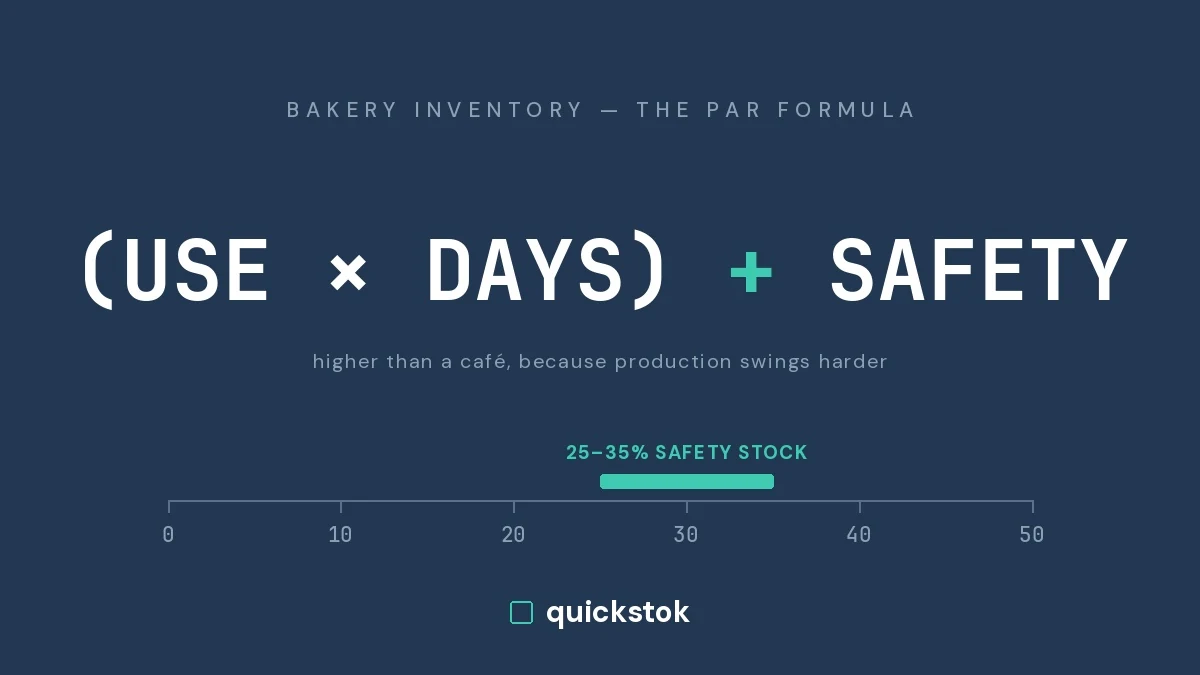
Par Level = Average Weekly Usage × Weeks of Buffer + Safety Stock
Let's break that down with a real example.
Example: Oat Milk
Say your café goes through about 6 cases of oat milk per week. Your supplier takes 3 days to deliver after you place an order. You want a small cushion in case of a busy weekend or a late delivery.
- Average weekly usage: 6 cases
- Buffer (1.5 weeks): 6 × 1.5 = 9 cases
- Safety stock (for surprises): 2 cases
- Par level: 11 cases
This means: when you count your oat milk and see 11 cases or fewer, it's time to order.
Example: Espresso Beans
Your shop uses about 10 lbs of espresso beans per week. Your roaster delivers in 5 days.
- Average weekly usage: 10 lbs
- Buffer (1.5 weeks): 10 × 1.5 = 15 lbs
- Safety stock: 3 lbs
- Par level: 18 lbs
When you're at 18 lbs or below, place that order.
Why Par Levels Matter More Than You Think
Without par levels, you're guessing. And guessing leads to two expensive problems:
Stockouts — Running out of a key ingredient means lost sales, disappointed regulars, and emergency runs to Costco at a markup.
Over-ordering — Buying too much ties up cash, takes up storage space, and leads to waste when perishables expire.
Par levels sit right in the middle. They're your Goldilocks number.
Common Mistakes Café Owners Make
1. Setting Par Levels Once and Forgetting Them
Your usage patterns change with seasons, new menu items, and foot traffic trends. A par level set in January might be completely wrong by June. Review and adjust quarterly at minimum.
2. Using the Same Buffer for Everything
Not all items are equal. Oat milk and cups are critical — running out stops service. Vanilla syrup is important but you can survive a day without it. Set tighter pars for mission-critical items and looser ones for nice-to-haves.
3. Ignoring Supplier Lead Times
If your espresso roaster takes 5 days to deliver but your dairy supplier delivers next-day, your par levels need to reflect that difference. A 3-day buffer works for next-day delivery but not for a week-long lead time.
4. Not Accounting for Variability
If your busiest day does 2x your average, your safety stock needs to cover that spike. Look at your peak usage, not just your average.
How to Track Par Levels in Practice
The simplest approach: create a spreadsheet with columns for Item, Par Level, Current Stock, and Order Needed. Do a count weekly and compare. If you need a ready-made starting point, we have a free café inventory count sheet template with 50+ items and a variance formula built in.
Once you've set your par levels, you need a system for your team to actually count against them — here's how to build a staff counting workflow that sticks.
The downside? It's manual, error-prone, and nobody enjoys doing it at 6am before the morning rush.
Tools like QuickStok can calculate par levels automatically from your receipt uploads and inventory counts — adjusting as your usage patterns change over time. But whether you use a spreadsheet or software, the important thing is having par levels at all.
Adjusting Par Levels Over Time
Your par levels should evolve. Here's when to revisit them:
- New menu item launches — that trending lavender latte is going to change your syrup usage
- Seasonal shifts — iced drinks spike in summer, hot drinks in winter
- Supplier changes — new vendor with different lead times
- After a stockout — if you ran out, your par was too low
- After excess waste — if you're throwing things away, your par was too high
The best café operators review par levels monthly and make small adjustments rather than big reactive changes.
The Bottom Line
Par levels are simple in concept but powerful in practice. They turn "I think we need more cups" into "we need to order cups when we hit 4 cases." That shift from guessing to knowing is what separates cafés that run smoothly from ones that are always scrambling.
Start with your top 10 highest-usage items. Calculate their par levels using the formula above. Stick them on a sheet near your storage area. You'll feel the difference within a week.