How Much Inventory Should Your Coffee Shop Keep? The Reorder-Point Method
A café should reorder each item when its stock falls to its reorder point — roughly (daily usage × delivery lead time) + a small safety buffer — not when the shelf looks empty, and not on a fixed weekly schedule. For a shop that goes through 5 liters of oat milk a day with a 3-day delivery window, that reorder point lands around 25 liters, or about a case and a half. This guide gives you the formula for every item, explains why one fixed "par" number quietly causes both stockouts and waste, and shows when to graduate from par levels to usage-based ordering.
What is a reorder point, and how is it different from a par level?
A par level is the target amount you want on hand — the level you restock back up to. A reorder point is different: it's the trigger level that tells you when to place the order so the delivery arrives before you run out.
The gap between the two is your delivery lead time. If a par level says "keep 30 liters of milk," that's your target. But if you wait until you're nearly out of 30 liters to order, and delivery takes three days, you'll be pulling shots on fumes by the time the truck shows up. The reorder point answers the question par levels can't: at what stock level do I need to act today?
If you're still setting up par levels in the first place, start with what a par level is and how to set one — the reorder point sits on top of that foundation.
A par level tells you your target; a reorder point tells you when to act on it — and the gap between them is your delivery lead time.
How do you calculate a reorder point for a café?
The formula is simple:
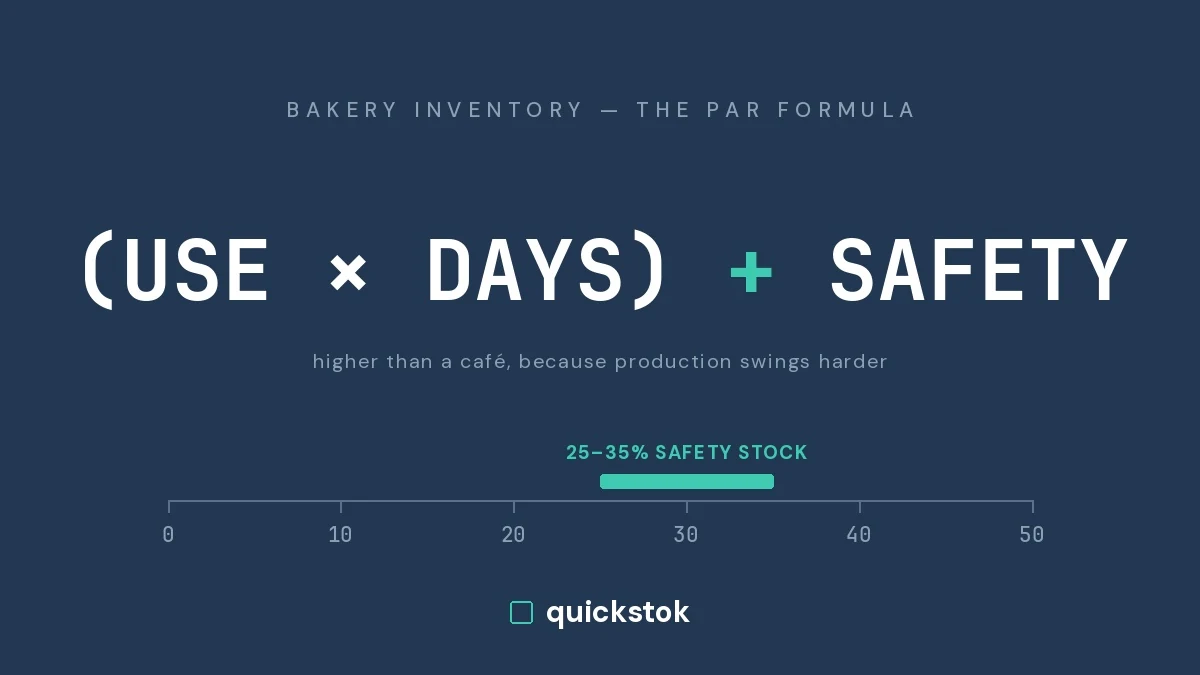
Reorder point = (average daily usage × lead time in days) + safety stock
You need three numbers:
- Average daily usage — how much of the item you go through per day, pulled from a few weeks of counts or sales.
- Lead time — the days between placing an order and the delivery landing.
- Safety stock — a buffer for busy weekends and the occasional late delivery. The simplest version is one to three days of usage.
Worked example — oat milk: 5 L/day, a 3-day lead time, and a 2-day safety buffer. (5 × 3) + (5 × 2) = 15 + 10 = 25 L. When your oat milk drops to 25 liters, it's time to order.
Worked example — espresso beans: 1.2 kg/day, a 5-day lead from a specialty roaster, and a 3-day buffer. (1.2 × 5) + (1.2 × 3) = 6 + 3.6 = 9.6 kg, which you round up to 10 kg because beans ship in 1 kg bags.
That rounding step matters: your reorder point should always round up to the unit you actually buy in. You can't order 9.6 kg, so the practical trigger is 10 kg.

Multiply daily usage by your lead time, add a one-to-three-day buffer, and round up to your purchase unit — that number is your reorder point.
Why does one fixed par level cause both stockouts and waste?
Here's the trap most cafés fall into: they set a single par level per item and treat it as the whole answer. But a static par ignores the two things that actually matter — how fast an item moves and how long resupply takes.
Set your par high enough to survive your busiest weekend, and your slow movers overstock and spoil. Set it for the average week, and your fast movers run dry every Saturday. The same number can't be right for both, because milk and a niche lavender syrup don't behave the same way. A fast mover burns down hard between deliveries and needs a reorder point well above its resting par; a slow mover ties up cash and shelf life if you keep too much on hand.

This is exactly how a café ends up over-ordering and throwing money away on some items while running short on others — often in the same week. Milk is usually the clearest offender, which is why it's worth measuring your milk waste directly before you trust any par number.
A fixed par level is a single guess applied to items with very different speeds — which is why the same number leaves you short on milk and overstocked on syrup in the same week.
When should you switch from par levels to usage-based ordering?
Reorder points are a big upgrade over flat par levels, but they still rely on a fixed estimate of daily usage. The most accurate approach orders by cover days instead: stock ÷ daily usage = how many days of runway you have left. As your café's demand shifts — a new drink takes off, summer iced season hits — cover-day timing adapts on its own.
The catch is data. In your first few weeks you simply don't have enough history for cover-day math to be trustworthy, so par levels and a basic reorder point are the right tools. After roughly four delivery cycles, you have enough real consumption history to switch that item over to usage-based timing.
This is the model QuickStok's reorder engine uses: a new item stays on par-based ordering until it's seen about four delivery cycles, then it graduates to usage-based timing and flags you when you're days from running out — instead of waiting for it to hit a static floor. Items that move erratically stay on par on purpose, because cover-day math would mislead on lumpy demand.
Use par levels for the first few delivery cycles, then switch each item to usage-based timing once you have about a month of real ordering history.
How do you order for lumpy or seasonal items?
Not everything moves smoothly. A seasonal syrup, floor cleaner, or to-go bags bought by the case sell in bursts — so "average daily usage" is misleading, because the average is a number the item never actually uses in any given week.
For these, skip the usage formula. Keep a simple minimum-stock floor and respect your supplier's minimum order quantity (MOQ). If cups ship 1,000 to a case, your reorder point is really "before I drop below one case's worth of runway," not a precise daily-usage calculation. Durables like equipment and gloves are even simpler — just hold a floor and reorder when you near it.
For burst-demand and bulk items, skip the usage formula and set a simple floor tied to your supplier's minimum order quantity.
How often should a coffee shop place orders?
Reorder points tell you what needs attention; they don't mean you place a separate order every time one item dips. Tie your actual ordering cadence to your suppliers' delivery days and each item's shelf life.
Order perishables — milk, pastries, fresh produce — on your supplier's most frequent delivery day. Batch dry and durable goods less often. The reorder point flags which items are getting urgent across the week; your delivery calendar decides which day you bundle them into one order. Accurate usage numbers depend on consistent counts, so a counting system your staff actually follow is what makes all of this work.
Let each item's reorder point tell you what's urgent, and your suppliers' delivery days tell you when to bundle the order.
Putting it together
To stop guessing how much to order:
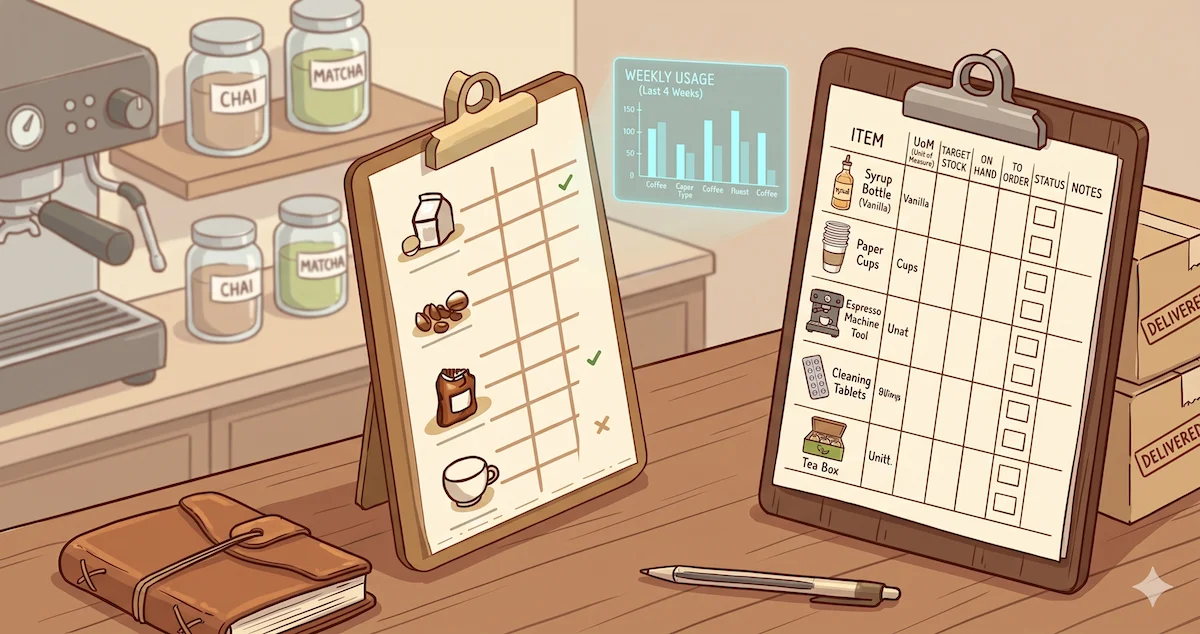
- Set a par level (target) for each item.
- Calculate a reorder point: (daily usage × lead time) + safety buffer, rounded up to your purchase unit.
- Order each item when it hits its reorder point — bundled onto your supplier's delivery day.
- After about four delivery cycles, switch steady movers to usage-based (cover-day) timing.
- Keep lumpy and bulk items on a simple floor tied to MOQ.
If you're tracking all of this in a spreadsheet, the math is doable but it goes stale the moment usage shifts — which is the point where most cafés move to an AI tool that recalculates reorder timing automatically as the numbers change.
The right amount of inventory isn't a single par number — it's a reorder point per item that accounts for how fast it moves and how long it takes to arrive.